Key takeaways
- Government interviews in Pakistan test subject knowledge, current affairs and confidence, not just your CV.
- Prepare a short, clear introduction and know your own application form inside out.
- Carry original documents, attested copies and your CNIC, and reach the venue early.
- Practise answering in a calm, honest tone instead of memorising long answers.
- Follow up politely after the interview and keep applying elsewhere while you wait.
Why Government Interviews Feel Different
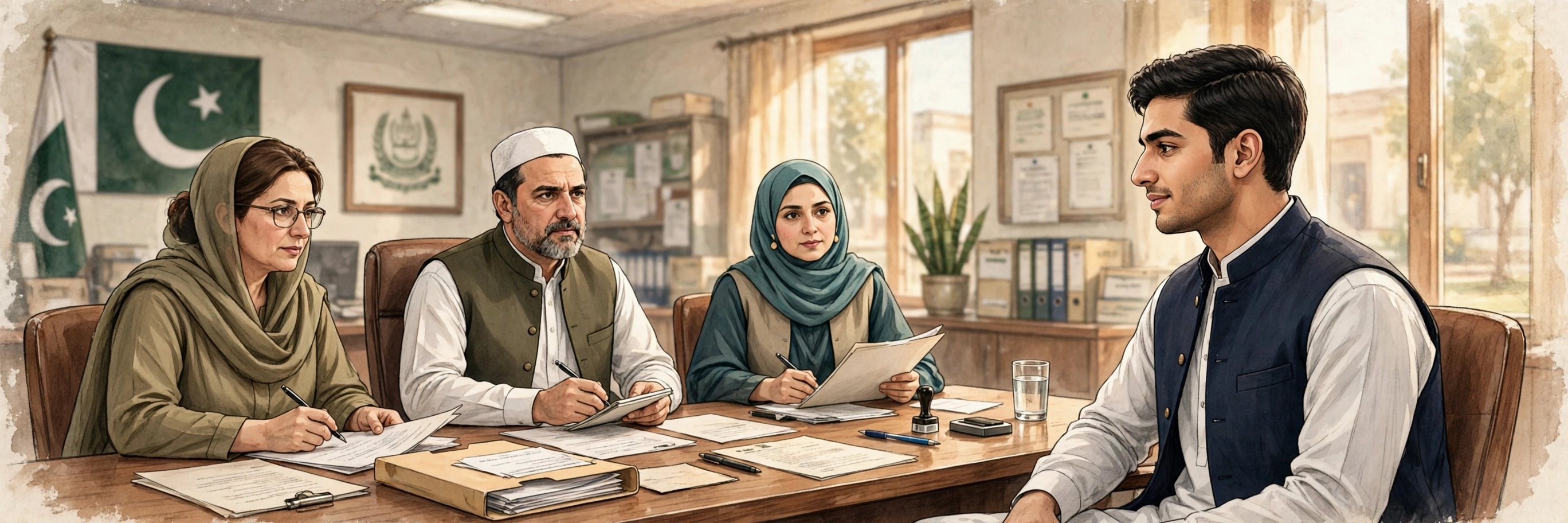
A government job interview in Pakistan is not like a private company interview. The panel usually has three to five members, including a chairman, a subject specialist and a psychologist or a senior officer from the department. They already have your written test result in front of them, so the interview is not about proving you can pass an exam. It is about checking whether you are the person your documents say you are, whether you understand the job, and whether you can be trusted with public responsibility.
Many strong candidates fail here not because they lack knowledge but because they walk in unprepared for the format. The questions jump between your subject, Pakistan's current affairs, your hometown, your degree and sometimes a question designed only to test how you react under pressure. If you prepare for that variety, the interview becomes much easier.
Start With the Job Itself
Before you prepare anything else, read the original advertisement again. Note the department, the post name, the basic pay scale and the duties the post involves. Then visit the department's official website and read what it actually does. A candidate for a post in the education department who cannot explain the department's main programmes looks careless, while a candidate who mentions one or two real programmes stands out immediately.
Also read your own application form once more. Panels often ask about anything written on it: your final year project, a gap in your education, a previous job, or a hobby you listed. If you wrote it, you should be ready to talk about it. Do not list a hobby you cannot discuss for two minutes.
Prepare Your Introduction
Almost every interview starts with "introduce yourself" or "tell us about yourself". Keep it short, about one minute, and structured: your name, your education, one or two relevant strengths, and why you want this post. Do not repeat your whole CV. The panel has it already.
Practise saying it out loud three or four times. A rehearsed introduction is not cheating, it is preparation, and it calms your nerves for the questions that follow. Keep the tone natural. If you sound like you are reciting a memorised paragraph, the panel will notice.
Revise Your Subject, Not Everything
You cannot revise your whole degree in a week, and the panel does not expect it. Focus on the core subjects of your field and the basics that every graduate should know. For example, an accounts candidate should be confident about budgeting and basic accounting terms, a computer science candidate about databases and programming basics, and a general candidate about Pakistan Studies, Islamiyat and English grammar.
Spend at least as much time on current affairs. Read the main headlines of the last two to three months: the federal budget, major government policies, the names of the chief ministers and governors, Pakistan's relations with neighbouring countries, and any major development in the department you applied to. Panels love asking about a recent news item, and a candidate who reads the news daily has a clear advantage.
The Questions You Will Almost Certainly Face
Some questions appear in nearly every government interview. Prepare honest answers for these:
- Why do you want a government job instead of a private one?
- Why should we select you for this post?
- What do you know about this department?
- What are your strengths and weaknesses?
- Where do you see yourself in five years?
- What will you do if you are posted far from your home city?
Answer honestly and briefly. For weaknesses, name a real one and say what you are doing about it. Saying "I have no weakness" is the worst possible answer. For the five year question, connect your answer to the department, not to a plan to leave for another job.
Documents: Get Them Ready the Night Before
Government interviews are strict about documents, and missing papers have ended many interviews before they began. Pack the following the night before:
- Your original CNIC and two photocopies
- Original degrees, transcripts and certificates with attested photocopies
- Domicile certificate and PRC if the post requires it
- Experience certificates if you claimed experience
- Your interview call letter and two recent passport size photographs
- The application form copy if you have one
Check the call letter for any extra requirement, such as a fee receipt or a NOC from your current employer. Government employees applying for another post must usually bring a departmental permission letter, so arrange it in advance.
Dress, Timing and Body Language
Dress formally and simply. For men, a clean shalwar kameez with a waistcoat or a shirt with trousers and a tie both work. For women, a neat formal dress in a plain colour is best. Avoid loud colours, heavy perfume and flashy accessories. The panel forms an impression in the first few seconds, and neatness signals discipline.
Reach the venue at least 30 minutes early. Late arrival is almost never forgiven in a government interview. When you enter, greet the panel, sit only when asked, keep your hands still and make eye contact with the member who asked the question. Speak slowly enough to be understood. If you do not know an answer, say so politely instead of guessing. Panels respect honesty far more than a confident wrong answer.
Handling Pressure Questions
Sometimes a panel member will disagree with you, interrupt you, or ask a question with no clear answer, only to see how you react. Stay calm, listen fully before answering, and do not argue. A polite "Sir, I understand your point, and in my view" is far better than a debate. If two members ask at once, answer the senior member first and then address the other.
If you feel nervous, pause for a second and take a breath before answering. A short pause looks thoughtful, while a rushed answer often sounds confused.
After the Interview
Thank the panel briefly and leave calmly. Do not ask when the result will come or try to contact panel members afterwards. Results in government recruitment take weeks or months, and departments announce them on their official websites. Keep checking the official site and keep applying for other posts while you wait. Never pay anyone who promises to influence your result. Genuine government recruitment never asks for money beyond the official advertised fee.
Final Word
A government interview rewards the candidate who is prepared, honest and calm. You do not need to know everything. You need to know your subject's basics, understand the department, carry your documents and answer in your own words. Prepare for a week, practise your introduction, read the news, and walk in on time. That simple preparation puts you ahead of most candidates in the room.